Motte & bailey castles, mound by mound.
What a motte and a bailey were, why the Normans built hundreds of these castles after 1066, how a team could raise one in weeks, who lived and worked in them, and where you can still see them in England, Wales and Scotland. Every fact is checked against English Heritage, Cadw, Historic Environment Scotland, The National Archives and Britannica, and where they disagree we show both.
The short version
The motte is a man-made mound of layers of earth and stone, usually shaped like an upside-down pudding bowl, with steep sides and a flat top. English Heritage blog: How to spot a castle hiding in plain sight On top, the Normans built a rectangular timber tower (the keep, or donjon) and dug a deep ditch around the outside. English Heritage blog: How to spot a castle hiding in plain sight
The bailey was the fenced outer enclosure, with the buildings of daily life and pens for animals. English Heritage blog: How to spot a castle hiding in plain sight The sides of the motte and the earth banks were topped with timber palisades: wooden posts fitted so closely together that they formed a solid wall. English Heritage blog: How to spot a castle hiding in plain sight
Led by William the Conqueror, the Normans built hundreds of motte-and-bailey castles to take control of England after 1066, and many castles in Wales, Scotland and Ireland too. Britannica Kids (Students): Castle English Heritage calls the motte and bailey the most common type of earthwork castle, and the real Norman innovation. English Heritage blog: How to spot a castle hiding in plain sight
From the late 11th century, motte-and-bailey castles began to be replaced by stone keep castles, which were stronger and less likely to catch fire. Britannica Kids (Students): Castle
Start exploring
Built in weeks, not years
They were quick to build, and could be put up by unskilled forced labourers using basic materials. English Heritage blog: How to spot a castle hiding in plain sight The first step was a rampart around the edge, dug within a few days. English Heritage blog: How to spot a castle hiding in plain sight
And then stone?
Often, as at Totnes, the wooden defences were later replaced in stone. English Heritage: Castles Through Time More on from timber to stone.
Enjoying the castles? Help keep the lights on.
This site is hand-built, fact-checked and free to read. If a fact, a game or one of Useless’s notes made you smile, a little support keeps it going and helps the network grow.
Motte & bailey castle printables
Fact-checked PDFs in A4 and US Letter, for KS2 and KS3 classrooms, families and castle visitors.
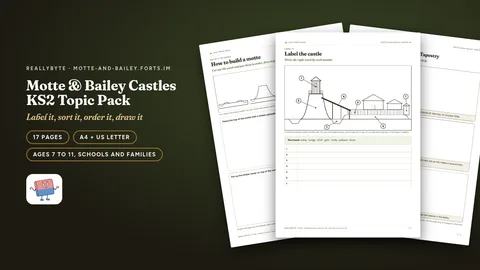
Motte & Bailey Castles KS2 Topic Pack
Ages 7 to 11, schools and families
Label a motte-and-bailey castle, motte or bailey sorting cards, a build-it-in-order sequencing sheet, a crossword where every answer is a real fact, a word search, a Bayeux-style comic strip, colouring, a certificate and an answer key
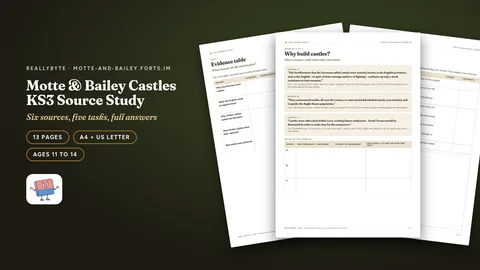
Motte & Bailey Castles KS3 Source Study
Ages 11 to 14
Why the Normans built castles after 1066, a primary-source reading of Orderic Vitalis, an evidence table, source-detective tasks on where the sources disagree, a change-and-continuity task from timber to stone, and full answers with sources
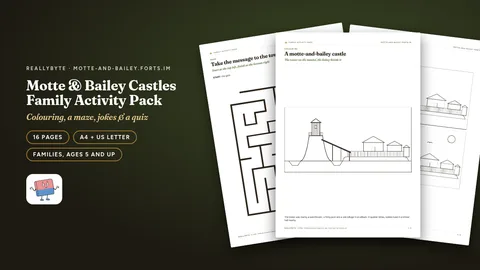
Motte & Bailey Castles Family Activity Pack
Families, ages 5 and up
Colouring pages, a castle maze, spot-the-difference, design your own motte-and-bailey castle, Useless the Eraser’s castle jokes and a quiz to do together
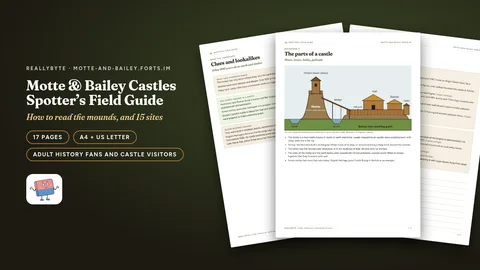
Motte & Bailey Castles Spotter’s Field Guide
Adult history fans and castle visitors
How to recognise a motte, a bailey and a ringwork in the landscape; lookalike mounds; how they were built; 15 example sites in England, Wales and Scotland with dates and sizes; and every place where the sources disagree
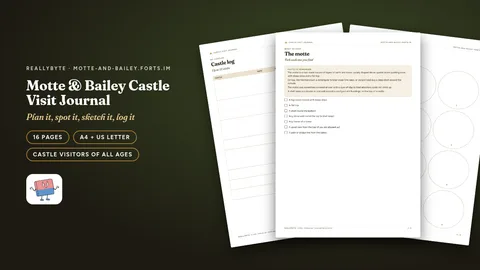
Motte & Bailey Castle Visit Journal
Castle visitors of all ages
Before-you-go checklist, what-to-spot tick lists for mottes, baileys, ditches and shell-keeps, sketch-the-castle pages, a castle log for up to 12 visits, and a visit stamps page
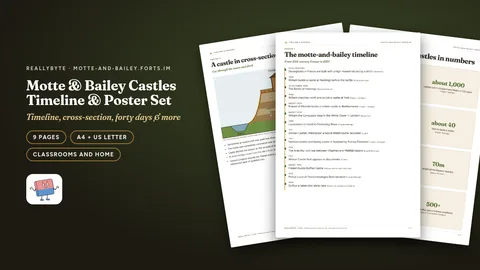
Motte & Bailey Castles Timeline & Poster Set
Classrooms and home
Six poster pages: a timeline from 10th-century France to 1925, how a motte-and-bailey castle worked, a castle in cross-section, building one in forty days, from timber to stone, and motte-and-bailey castles in numbers
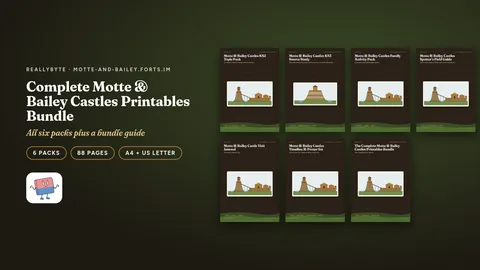 Best value
The Complete Motte & Bailey Castles Printables Bundle
All six packs plus a bundle guide, A4 and US Letter, in one download. $12.99 instead of $26.44 bought separately.